
Templates
A template is the design of a form: its pages and fields, its look, the roles that fill it in, and what happens when it is submitted. Each time a template is sent to someone, Cellosign creates a transaction from it. See Transactions.
To open the templates of a project, select the project at the top of the screen and click Templates in the left menu.
The Templates screen and the template editor are available to implementers, project managers and organization managers. Agents don’t see them: they choose from the published templates when they send a form. See Roles and permissions.
Template types
Section titled “Template types”| Type | What it is |
|---|---|
| HTML template | A responsive form that adapts to the screen of the person who fills it in. You build it from pages, sections, rows and fields. Cellosign creates the PDF document from the form. To create one, select HTML Template when you create the template. |
| PDF template | Fields placed on the pages of a PDF file that you upload. The person fills in the fields on the PDF pages. To create one, select From PDF file when you create the template. |
| Hybrid template | A PDF template that also has an HTML form. The person fills in the HTML form, and the values are placed in the fields on the PDF. See Hybrid templates. |
To create a template, see Create and import templates.
The Templates screen
Section titled “The Templates screen”The screen lists the templates of the selected project, 20 per page, the most recently updated first.
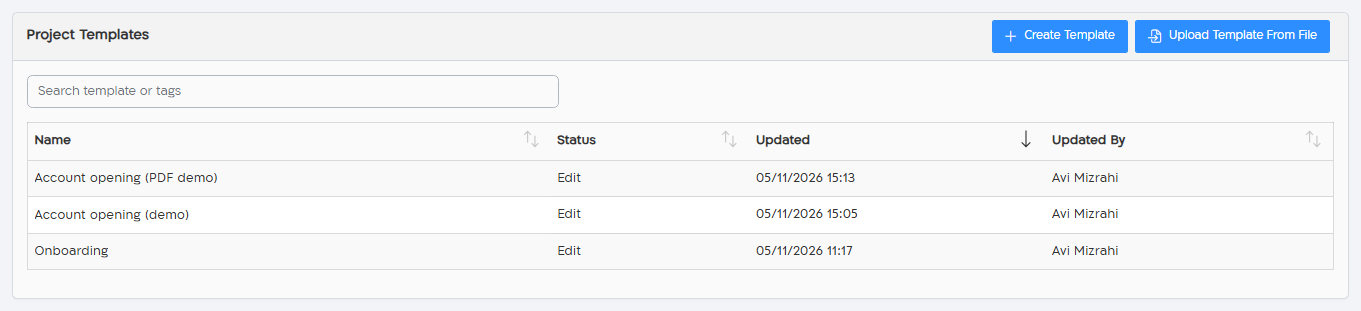
| Column | What it shows |
|---|---|
| Name | The template name and its tags. Point to a long name to see all of it. |
| Status | Publish or Edit. See Template status. |
| Updated | When the template was last saved. |
| Updated By | The user who last saved the template. |
Click a column heading to sort the list by that column. Click a template to open it in the template editor.
To find a template, type in Search template or tags. The list is filtered as you type. The search matches the template name, the template ID, the tags and the Updated By user, and is not case-sensitive. You add tags to a template on the Configuration tab, under Basic.
The buttons at the top of the screen:
| Button | What it does |
|---|---|
| Create Template | Creates an HTML template or a PDF template. See Create a template. |
| Upload Template From File | Imports a template from a .json or .cellosign file. See Import a template from a file. |
The list has no actions per template. To clone, export or delete a template, open it and use the editor toolbar.
Template status
Section titled “Template status”| Status | Meaning |
|---|---|
| Edit | The template is being worked on. New, cloned and imported templates start in this status. |
| Publish | The template is ready to use. |
Only published templates are offered when you start a transaction from the dashboard (Start process from template), and agents see only published templates. The status doesn’t stop a process or the API from using a template in Edit status.
To change the status, open the template and click Edit or Publish in the toolbar. See Change the status.
The template editor
Section titled “The template editor”The editor has a toolbar with the template’s actions, and these tabs:
| Tab | What you do there |
|---|---|
| HTML Template editor | Build the HTML form: pages, sections, rows and fields. |
| PDF Template editor | Place fields on the pages of the PDF. Shown for PDF and hybrid templates. |
| Design | Set the theme, colors and fonts of the form. |
| Configuration | Basic settings, messages and reminders, the workflow (roles), the data model, the templates sequence, JavaScript, the stylesheet, error messages and the custom PDF header and footer. |
| Information Security | Expiration, encryption and regulation settings, and the Safe for saving form data encrypted. |
| Integrations | The public link and the connectors. |
| Issues | Problems found in the template. Shown only when there are issues. |
To set up a single field, see Field settings.
Hybrid templates
Section titled “Hybrid templates”A hybrid template is a PDF template with an HTML form. The person who fills in the form sees the HTML form, which adapts to the screen. The values they enter are placed in the fields on the PDF.
To make a hybrid template:
- Create a PDF template and place its fields on the PDF pages.
- Click the HTML Template editor tab.
- Click Create HTML Template. All the fields of the template are added to one page of the HTML form, in the order they appear on the PDF, from the top down.
- Arrange the fields on the HTML Template editor tab. See HTML Template editor.
- Click Save.
A hybrid template has both the HTML Template editor and the PDF Template editor tabs. For how its fields work on the PDF, see Hybrid templates in the PDF Template editor.
To turn a hybrid template into an HTML template, remove its PDF with Erase PDF background. See Erase the PDF.